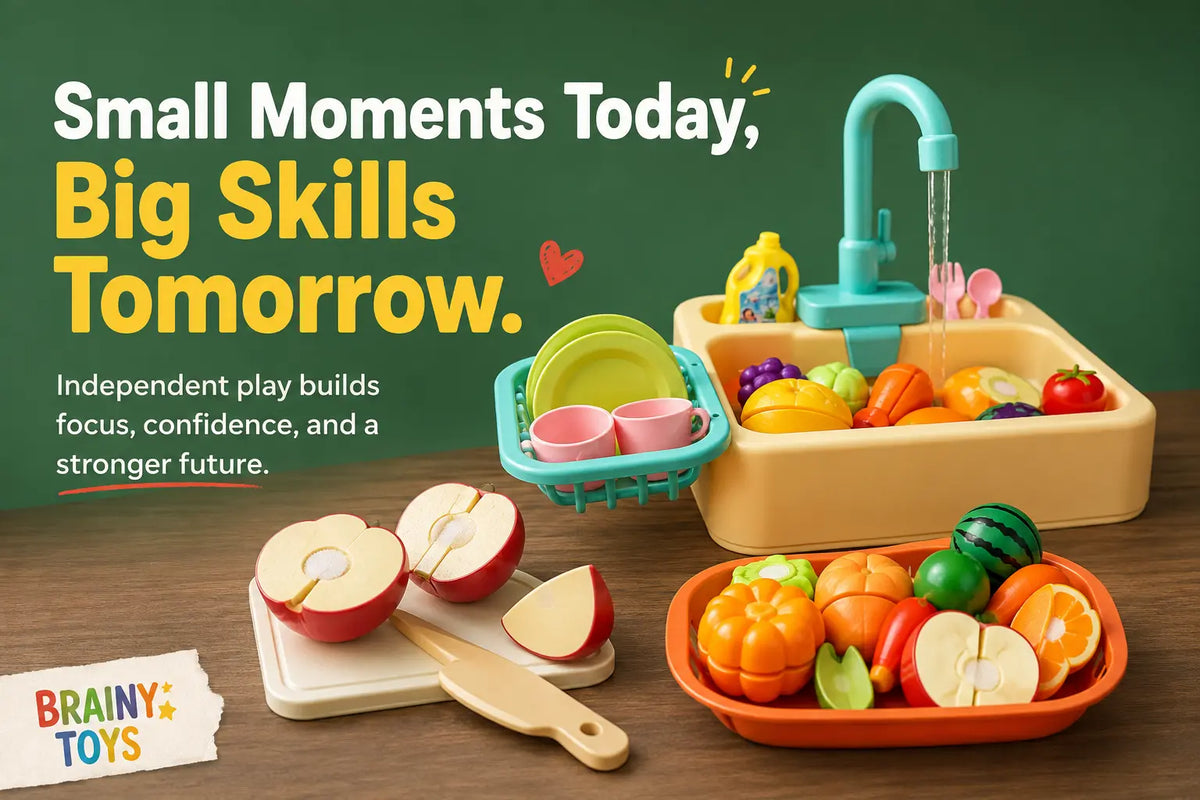
You need ten minutes to finish dinner, so you hand over a screen, and it works instantly. It works so well that it becomes the answer every time, and every day it gets a little harder to get your toddler to sit with anything else on their own. That's not a personality trait. Independent play is a skill, and it's built the same way most skills are: through practice, not through screens.
Independent Play Is a Skill, Not a Personality Trait
Pediatricians treat this as a real, measurable part of development, not a temperament quirk some kids have and others don't. The American Academy of Pediatrics' clinical report on play, published in 2018 and reaffirmed in 2025, states plainly that developmentally appropriate play builds the social-emotional, cognitive, and self-regulation skills that shape executive function (Yogman et al., 2018). Independent play is one form of that, and like any skill, it grows with repetition and shrinks with disuse.
At Brainy Toys, this is the question we hear most from parents: not "which toy should I buy" but "why won't my child play with anything for more than two minutes." The honest answer is usually that they haven't had much practice at it, because a screen kept solving the problem before the skill had a chance to build.
What a Screen Actually Replaces
A screen and independent play can look the same from across the room: the child is quiet, occupied, not asking for anything. The difference is what's happening underneath. A 2022 study following 2,213 Australian children found that time spent in quiet, unstructured free play between ages 2 and 5 predicted better self-regulation years later, even after controlling for the children's earlier self-regulation levels (Colliver et al., 2022). A screen doesn't ask a child to generate their own direction; it provides one, which is why the two can look identical but build something different.
That's the actual mechanism, not a vague claim that screens are bad. Free play works because the child decides what happens next. A screen works by deciding for them, which is exactly why it's effective at buying you ten minutes, and exactly why it doesn't build the same skill.
The Skill Underneath: Executive Function
Researchers at Harvard's Center on the Developing Child describe this cluster of skills as the brain's "air traffic control" system: the ability to hold onto information, filter distractions, and manage multiple things at once. No child is born with it. It's built through early, repeated chances to direct their own attention without an adult managing it for them (Center on the Developing Child, Harvard University, 2011).
Independent play is one of the few times in a toddler's day when nobody is managing their attention for them. That's precisely why it matters, and precisely why it's uncomfortable to sit through as a parent watching your child seem bored.
| Activity | Who directs it | Builds self-directed attention |
|---|---|---|
| Independent free play (drawing, blocks, pretend play, sorting) | The child | Yes (Colliver et al., 2022) |
| Screen time | The screen | No — attention is held, not self-generated |
| Adult-led activity (worksheets, guided craft) | The adult | Partly — builds compliance more than self-direction |
How to Actually Build It
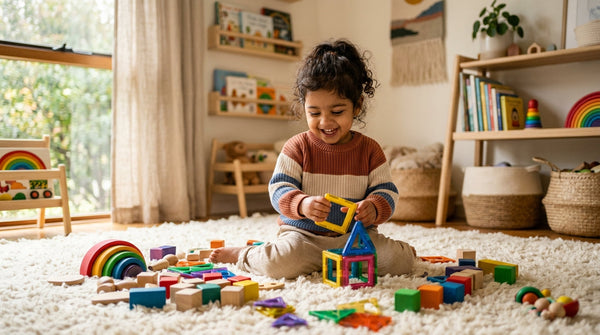
- Offer one open-ended option before a screen, not after. Blocks, paper and crayons, a basket of household objects to sort. Anything that doesn't tell the child what to do next.
- Stay nearby, but don't direct. Sit in the room if you need to, but resist narrating or suggesting the next step. The moment you take over, it stops being independent play.
- Let the first few minutes of boredom happen. Boredom is usually the on-ramp into self-directed play, not a sign something's wrong. Stepping in the second it appears removes the exact moment the skill would have kicked in.
- Start small and let the stretch grow on its own. Five minutes is a realistic starting point for a toddler, not thirty. The research is measuring daily repetition over months, not one long session.
- Offer independent play first, and let a screen be the fallback, not the default. If the answer to "I'm bored" is always a screen before anything else gets a chance, the habit never gets the room to form.
Frequently Asked Questions
Isn't it normal for toddlers to need a lot of attention?
Yes, and this isn't about withdrawing it. Connection and independent play aren't competing needs, and a toddler who feels secure with you nearby is usually more willing to try something on their own, not less. The goal is a few minutes of self-directed play stacked on top of a securely attached day, not less attention overall.
What age can independent play realistically start?
Earlier than most parents expect, even if it looks like a minute or two at first. The AAP's clinical report treats play-based skill-building as relevant from infancy onward, with independent stretches naturally lengthening as a child's attention and coordination develop (Yogman et al., 2018).
My toddler cries the moment I leave the room. What then?
Stay in the room without directing, rather than leaving. Independent play doesn't require physical distance, just that you stop managing what happens next, and proximity without direction is still independent play. It's a realistic starting point for a clingy toddler.
Does encouraging independent play mean ignoring my child?
No, it means being present without running the activity. You're still in the room, still available, just not narrating or steering, and the child is doing the deciding, which is the entire point.
Pick one moment today, ideally the one where you'd normally reach for a screen, and offer an open-ended option instead. Stay in the room. Don't direct. That's the entire method, and it's smaller than it sounds.
It's also the thinking behind why Brainy Toys exists: not that screens are the enemy, but that a child needs real chances to direct their own attention, not just fill it. If you want to see how we think about that in practice, our Montessori-inspired collection is built around exactly this idea, and our piece on what Montessori actually means at home goes deeper into the philosophy behind it.