Walk down any street in Karachi or Lahore and three preschools will have "Montessori" on the gate. Open a toy listing on google and half the wooden blocks carry the same word. Parents pay a premium for that label without knowing what it guarantees, and that gap costs real money on schools and toys that don't deliver on the name. This guide explains what the method actually is, so you can tell the real thing from the sign.
Where the Word "Montessori" Actually Comes From
Montessori is not a brand or a marketing term. It is the name of Dr. Maria Montessori, an Italian physician and educator who developed the approach more than a hundred years ago after observing how children learn when left to explore materials on their own terms, according to the American Montessori Society (AMS). She built a method around that observation, then trained teachers to use it in classrooms across Europe, and the approach spread from there to schools worldwide, including Pakistan.
That history matters because it means Montessori is a specific, documented set of ideas, not a general word for "educational" or "wooden." A toy or a school either follows those ideas or it does not.
The Four Ideas Every Real Montessori Classroom Is Built On
The American Montessori Society lists four principles that hold the method together. Each one has a direct, practical version at home.
- Whole-child development. The goal is not just academic skill but physical, social, and emotional growth together, so a good Montessori toy earns its place by more than teaching a letter or a number.
- Child-centered learning. The method treats children as naturally curious rather than needing to be pushed to learn, so materials invite a child to pick them up on their own, without an adult demonstrating first.
- Respect and independence. The child does the work, corrects their own mistakes, and moves at their own pace, since the adult's job is to prepare the environment, not direct every step.
- Real, purposeful materials. Objects are chosen for a specific developmental purpose, not as decoration, so a shape sorter earns its place because it teaches matching and fine motor control, not because it looks nice on a shelf.
Why "Montessori" on a Label Doesn't Always Mean Montessori
Here is the part most schools and toy listings in Pakistan will not tell you: the word "Montessori" was never trademarked. AMS states it directly on its own site: "any school can call itself Montessori, regardless of its fidelity to the philosophy and practice." Dr. Montessori never patented her method or restricted who could use her name, so legally, nothing stops a preschool or a toy seller from using the word whether or not they follow a single one of the four principles above.
This is not just a Western problem. Pakistan has its own recognized Montessori body, the Pakistan Montessori Association, affiliated with the Association Montessori Internationale (AMI), the same accrediting organization Dr. Montessori herself helped establish. Schools that hold real AMI or AMS affiliation have gone through training and review against the original method. A signboard alone tells you nothing; affiliation, or a materials list checked against the four principles above, tells you something.
The same logic applies at the toy shelf. A box that says "Montessori" is making a claim, not a guarantee. What is inside the box is what you should be judging.
Montessori vs Regular Toys: What's the Real Difference
The clearest way to see the difference is side by side. This is not about which is "better" in every situation, since battery toys have their place, but about what each one is actually designed to do.
| Feature | Regular / Battery Toy | Montessori-Style Toy |
|---|---|---|
| Purpose | Entertain, often passively | Teach one specific skill (sorting, counting, fine motor control) |
| Feedback | Comes from lights, sound, or screen | Comes from the material itself: a shape either fits or it doesn't |
| Child's role | Watches or presses a button | Handles, tests, and corrects their own attempt |
| Material | Usually plastic, battery-powered | Usually wood or another natural material, no battery |
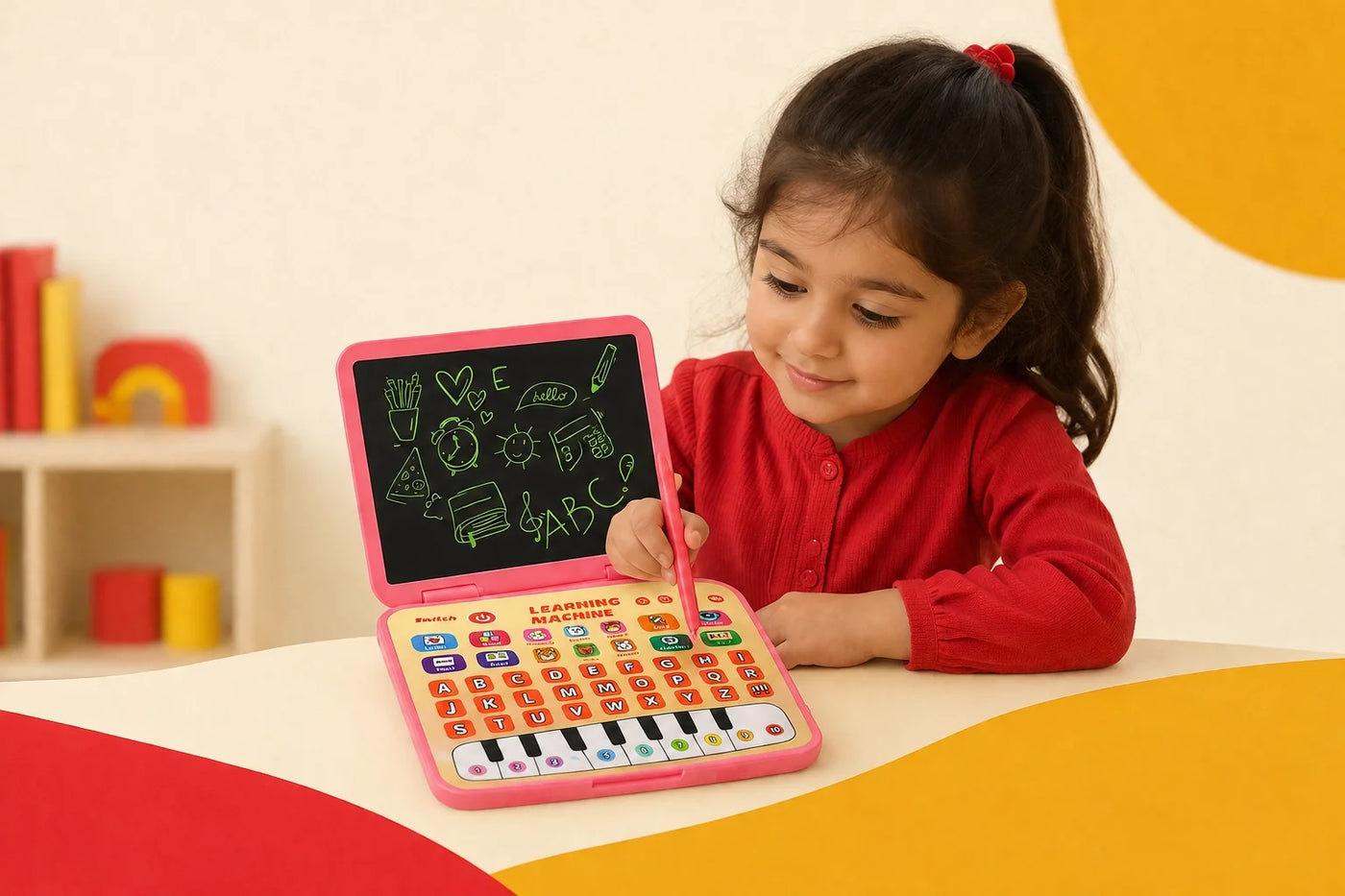
| Example | A toy laptop that plays sounds on tap | A wooden geometric shape sorter that only accepts the correct shape in each slot |
That self-correcting property (the shape either fits or it does not, with no adult needed to say "wrong") is the single feature that separates a genuine Montessori-style toy from one that just borrows the name.
Does the Method Actually Work? What the Research Says
The most-cited evaluation of Montessori education is Lillard and Else-Quest's 2006 study in the journal Science, which compared children in a Montessori public school to children in other school types matched for the same neighborhood and income level. The Montessori group scored higher on measures of executive function, early reading and math, and social problem-solving by the end of kindergarten.
A separate 2013 paper by the same lead researcher, published in the American Journal of Play, looked specifically at why Montessori materials are built the way they are: self-correcting, one skill at a time, hands-on. It concluded that this structure is what lets a child learn through play without needing constant adult correction. That is the research basis for principle four above, where the material does the teaching, not the packaging.
Neither study claims Montessori toys alone replicate a full Montessori classroom. What they support is narrower and still useful: toys built on the same self-correcting, hands-on logic as classroom materials support the same skills the classroom is designed to build.
Bringing Montessori Home: What to Actually Look For
You do not need an AMI-accredited classroom to apply the method at home. Four questions do most of the filtering:
- Does it correct itself? If a child needs an adult to say "that's wrong" every time, it is not self-correcting.
- Is it one skill, not ten? A toy that teaches shapes, colours, numbers, and animal sounds at once teaches none of them well.
- Is it real material? Wood, metal, and fabric give honest weight and texture feedback that plastic and lights do not.
- Can the child use it without you? If it needs a parent to operate it, it is not built for independence.
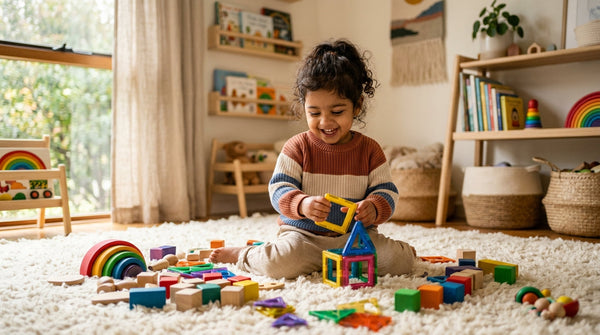
Our Montessori Toys collection and Wooden Toys collection are both filtered around these four questions rather than around the word "Montessori" alone. A magnetic building blocks set, for example, passes on all four counts: it self-corrects through fit, targets one core skill (spatial reasoning), uses solid pieces instead of a screen, and works without a parent standing over it.
Montessori Toys by Age, at a Glance
The right materials change by age because a two-year-old and a six-year-old are working on different skills. Live prices from our own catalogue, checked today:
| Age Band | Skill Focus | Price Range (PKR) |
|---|---|---|
| 0-1 years | Sensory exploration, grasping | Rs 899 – Rs 2,699 |
| 1-3 years | Sorting, stacking, early language | Rs 799 – Rs 3,199 |
| 3-5 years | Fine motor precision, early literacy | Rs 699 – Rs 4,730+ |
| 5-8 years | Logic, sequencing, independent projects | Rs 2,299 – Rs 6,899 |
For the full breakdown by age with specific product picks, see our complete age-by-age Montessori toy guide.
FAQs
Is Montessori the same thing as homeschooling?
No. Montessori is a teaching method that a school, a home, or a mix of both can use. Most Montessori-educated children in Pakistan attend a physical school; the method describes how the classroom and materials work, not where the child learns.
Do I need official Montessori-branded materials, or will any wooden toy do?
Any toy that meets the four questions above (self-correcting, one skill, real material, usable independently) applies the same principles, regardless of the brand printed on the box. The AMS accreditation matters for schools claiming full Montessori status, not for individual toys.
Is Montessori education recognized in Pakistan?
Yes. The Pakistan Montessori Association is affiliated with the Association Montessori Internationale (AMI), the international body co-founded around Dr. Montessori's own training standards, and a growing number of Pakistani preschools now train teachers against that standard rather than using the name loosely.
What age should I start using Montessori-style toys at home?
From around six months, once a baby can sit up and grasp objects with purpose rather than by reflex. The four questions above apply at every age after that; only the specific skill each toy targets changes as the child grows, moving from grasping and stacking toward sorting, counting, and early letters.
Are Montessori-style toys always more expensive than regular toys?
Not necessarily. In our own catalogue, Montessori-style pieces start under Rs 900 for the youngest age band, similar to a mid-range battery toy. The price difference, where it exists, usually reflects the material (wood versus plastic) rather than the Montessori label itself.