A toddler goes quiet the moment a phone appears — during a doctor's queue, a guest's visit, dinner prep — and the quiet is so useful that the phone becomes the default. Every week that habit continues, the screen gets harder to remove and the toys already at home get touched less. The WHO caps screen time at zero before age 2 and one hour after; this guide gives Pakistani parents a concrete plan to hit that number.
Why the Habit Forms So Fast in Pakistani Homes
Pakistani households run on hospitality: a doctor's visit, a rishta meeting, an evening of guests. A toddler who cries through any of it embarrasses the whole house, so a phone solves that in seconds, and every adult in the house reaches for it, not just the parents.
Meals follow the same pattern. A phone with a cartoon on loop gets a toddler to sit still and finish a plate of daal-chawal, so the habit repeats at every meal until the child expects a screen with food.
This isn't unique to one family. A 2023 study of 200 preschoolers across four private schools in Islamabad found screen habits tracked closely with the mother's employment status and the child's age. The more a household needed a reliable babysitting tool, the more screen time crept in (Suleman et al., Pakistan Journal of Medical Sciences, 2023).
What the Research Actually Shows
The World Health Organization's 2019 guideline on physical activity, sedentary behaviour and sleep for children under 5 sets the clearest numeric benchmark available:
| Age | WHO-Recommended Screen Time |
|---|---|
| Under 1 year | None |
| 1 year | None |
| 2–4 years | Up to 1 hour a day; less is better |
The American Academy of Pediatrics takes a different angle: its current guidance drops a fixed hourly limit and instead asks parents to judge quality — what the child is watching, whether an adult is watching with them, and whether screen time is crowding out sleep and active play. Video chatting with family counts as connection, not screen time, under this framework.
The direction of the effect matters as much as the amount. Madigan et al. followed children through ages 24, 36 and 60 months and found that more screen time at an earlier age predicted weaker performance on developmental screening tests later, not the reverse (JAMA Pediatrics, 2019).
The Islamabad study adds a Pakistan-specific data point neither international guideline can give. Of the 200 preschoolers surveyed, 41 (20.5%) logged more than 60 minutes of screen time a day. On the Child Behavior Checklist, that group scored measurably higher on withdrawal (11.94 vs. 10.72, p=0.014), sleep problems (10.97 vs. 9.90, p=0.010), and autism-spectrum-scale items (17.66 vs. 16.17, p=0.047) than the group under the WHO's own 60-minute ceiling.
Signs Your Toddler Already Has Too Much Screen Time
Watch for these patterns before deciding a swap plan is even necessary:
- Meltdowns specifically at screen removal, not at ordinary transitions. This is the withdrawal pattern the Islamabad study measured.
- Harder time settling at bedtime on days with more screen exposure, even if the screen was off hours earlier.
- Toys get abandoned within minutes while the same child stays fixed on a screen for 30+ minutes.
- Blank or delayed response to their name while a screen is on, compared to normal responsiveness otherwise.
- Speech that lags behind other children the same age: worth a pediatrician conversation, not a home fix alone.
The Swap Plan: Screen-Free Toys by Age
A swap only works if the replacement toy asks for the same thing the screen was giving: something to look at, touch, or control without needing an adult to run it.
Ages 1–3
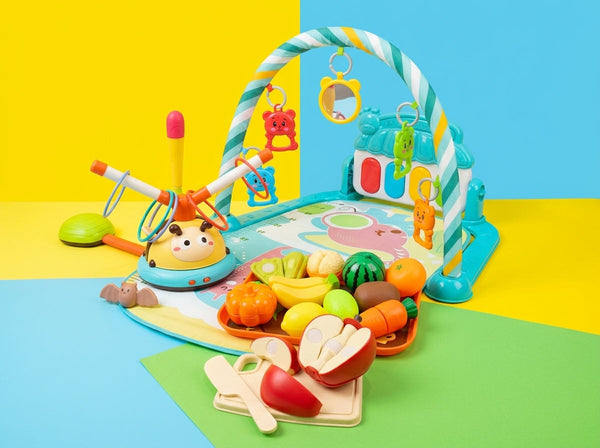
At this age the screen is usually filling downtime: car rides, waiting rooms, the ten minutes before dinner is ready. A Busy Bear Shake Rattle (Rs. 1,990) or a Spinning Puffer Fish sensory rattle (Rs. 1,300) gives a toddler something to shake, spin and mouth-explore in exactly those windows, with no charging and no screen glow to fight at bedtime.
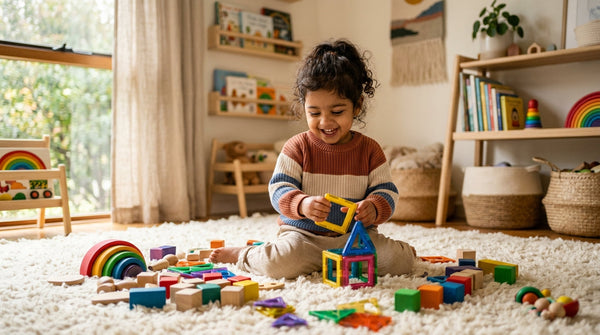
For slightly longer stretches, a Rainbow Wooden Stacker Toy (Rs. 900) or the Busy Montessori Sensory Book (from Rs. 2,470) holds attention through the same open-ended manipulation a phone offers, but builds a grip and a hand instead of a habit. Browse the full 1–3 years collection for more of this range.
Ages 3–5
Preschoolers can sustain independent play longer, so the goal shifts from occupying five minutes to filling the 20–30 minute block a cartoon used to hold. A Wooden Geometric Shape Sorter (Rs. 1,000) or a Magnetic Building Blocks Set (Rs. 2,850) gives a real construction goal, which is what keeps a preschooler at the table without a parent hovering.
| Screen habit | Screen-free swap | Why it works |
|---|---|---|
| Phone during meals | Busy Montessori Sensory Book | Keeps hands occupied without needing an adult to operate it |
| Tablet on car rides | Busy Bear Shake Rattle | Portable, no charging, quiet enough for a moving car |
| Cartoon as a “calm down” tool | Rainbow Wooden Stacker Toy | Same open-ended manipulation a screen offers, without the glow before sleep |
| YouTube while a parent cooks | Magnetic Building Blocks Set | Gives a real building goal, holds independent attention for 15–20 minutes |
For a musical alternative to screen-based nursery rhyme videos, the Kids Wooden Xylophone (Rs. 900) lets a child make the sound themselves instead of watching someone else make it. The full Montessori toys collection covers this age range end to end.
A 2-Week Step-by-Step Plan to Cut Screen Time
Don't remove every screen at once. The withdrawal pattern in the Islamabad data is real, and a single hard cutoff invites the worst version of it.
Days 1–3: Log actual screen time honestly, slot by slot (meals, car rides, wind-down). Most parents underestimate this by half until they write it down.
Days 4–7: Pick the single highest-friction slot, usually mealtime, and swap it for one toy from the list above. Leave every other slot untouched this week.
Days 8–10: Once the first swap holds without a daily fight, add a second slot: car rides or the pre-dinner wait are usually next easiest.
Days 11–14: Shrink whatever screen time remains toward the WHO's one-hour ceiling for ages 2–4, and hold that line for two more weeks before attempting any further reduction.
Screen-Free Activities Beyond Toys
Toys aren't the only lever. Sorting dried lentils by color, rolling out atta dough into shapes, or stacking steel kitchen bowls all give a toddler the same hands-on, self-directed engagement a screen does, using things already in the kitchen. For a longer list built specifically around this age range, see our 5 screen-free activities for toddlers guide.
FAQs
How much screen time is okay for a 2-year-old in Pakistan?
The same WHO ceiling applies everywhere: no more than 1 hour a day for a 2-year-old, and less is better. There's no separate, more lenient standard for Pakistani households. The research gap here is Pakistan-specific outcomes, not a different recommended limit.
What if my toddler melts down when the screen goes off?
Expect it in the first 3–5 days of any swap; this matches the withdrawal pattern the Islamabad study measured. Hold the new routine steady through that window rather than reversing at the first tantrum; it typically eases once the replacement toy becomes familiar.
Are educational apps different from watching cartoons?
The AAP treats them differently in principle: content quality and whether a parent is co-viewing matter more than the raw category. But under 18–24 months, the AAP's guidance still favors no screen use beyond video-calling family.
What are the best screen-free toys for a 1-year-old?
Sensory rattles that reward shaking and spinning without needing an adult to operate them: the Busy Bear Shake Rattle and Spinning Puffer Fish rattle both fit this age and the short attention windows that come with it.
How long before a screen time reduction actually sticks?
Budget two to four weeks. The 2-week plan above gets a household to the WHO ceiling; holding that line for two more weeks is usually what makes the lower level the new normal rather than a temporary dip.
Start with the single hardest slot in your day, not the whole schedule. Pick one toy from the age band that matches your child and give it two weeks before judging whether it worked. For the age-by-age Montessori picture beyond screen time specifically, see our Montessori toys by age guide.