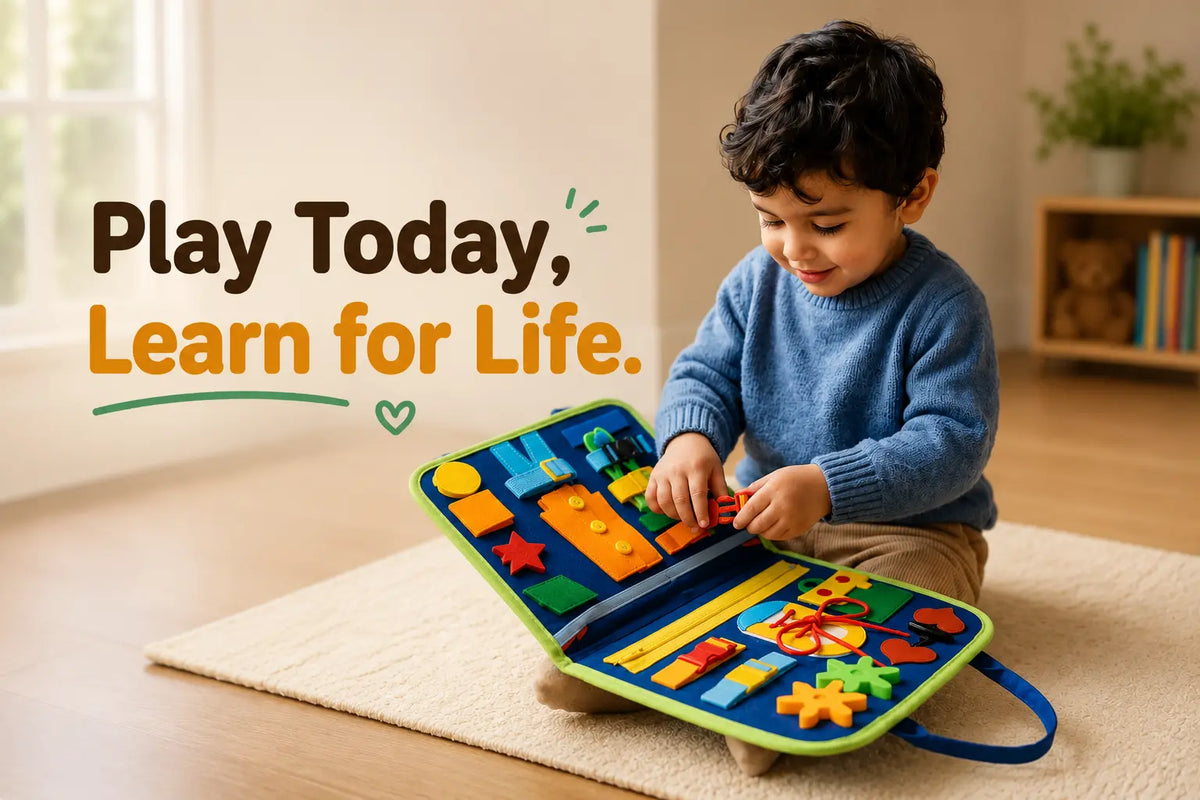
A colourful board covered in switches and zips looks like something to keep small hands busy for ten minutes, not something that teaches anything. But every latch a toddler works loose is the same fine motor practice occupational therapists use to judge school readiness, and most parents buy the board without knowing which parts of it actually matter. Here's what a busy board genuinely builds, and how to tell a good one from a shelf of switches.
What a Busy Board Actually Teaches
A busy board is a modern, all-in-one version of a much older Montessori material: the dressing frame. Each frame isolates one self-care skill, a button, a buckle, a zip, a lace, so a child masters it without an adult's help, a structure the Global Montessori Network's practical life curriculum documents as designed for children as young as two and a half.
That "one skill per element, no help needed" structure is what separates a real busy board from a flat panel of decorative stickers. A latch either closes or it doesn't; a zip either pulls or it catches. The child sees the result of their own hand immediately, with no adult saying right or wrong.
Our own Busy Montessori Sensory Book works on exactly this logic in a portable format: each page holds one fastener, so a toddler finishes one before moving to the next instead of getting ten features at once.
Why Fine Motor Practice Now Pays Off Later
Turning a knob, pulling a zip, and threading a lace are not just busywork. A 2010 study in Developmental Psychology followed children from kindergarten entry and found that fine motor skill, measured at that age, predicted later reading, maths, and science scores more strongly than a child's early reading or maths scores did on their own (Grissmer et al., 2010, 46(5), 1008-1017).
That finding doesn't mean a busy board makes a child smarter. It means the specific hand skills a busy board practises, grip, release, twist, pull, are the same skills researchers use as an early marker of how ready a child is for the structured schoolwork that follows a few years later.
A toddler doesn't need to understand any of this to benefit from it. They just need a board with fasteners hard enough to be a real challenge, not so hard that they give up before the latch gives way.
The Pakistan-Specific Evidence Most Listings Don't Mention
Most busy board product pages describe latches and buckles without saying why any of it matters for a child's development, a sentence stating a benefit but never a source behind it. A 2021 study specific to this question gives Pakistani parents a real answer.
Researchers followed 1,058 children in rural Pakistan from age 2 to age 4 and found that home stimulation at 18 months, hands-on play and interaction, not screen time, predicted real gains in fine motor skill over that two-year window, independent of the family's income or resources (Armstrong-Carter et al., 2021, Developmental Psychology, 57(6), 888-899).
The result held even after the researchers controlled for household wealth. A busy board is not the study's product, but it is exactly the kind of repeated, hands-on stimulation the study measured, and it costs a fraction of what many Pakistani parents already spend on toys that do the entertaining instead of asking the child to do the work.
Busy Board Skills by Age
A single busy board rarely fits every age well. A board built for a 4-year-old's zips and laces frustrates a 1-year-old who is still learning to grip, and a simple textured panel bores a preschooler who wants a real challenge.
| Age Band | Skill to target | Example from our catalog | Price (PKR) |
|---|---|---|---|
| 0-12 months | Grasp, spin, texture — no small fasteners yet | Spinning Puffer Fish Sensory Rattle | Rs 1,300 |
| 1-3 years | One fastener at a time: buttons, zips, buckles | Busy Montessori Sensory Book (4-page) | Rs 2,470 |
| 3-5 years | Multi-step fasteners combined on one page | Busy Montessori Sensory Book (8-page) | Rs 3,700 |
| 5+ years | Fine motor paired with building and planning | Magnetic Building Blocks Set | Rs 2,850 |
Browse the full 1-3 Years collection if your child is right at the edge between two bands; the safest call is the simpler board, not the more advanced one.
What to Look For in a Real Busy Board
A cheap busy board copies the look of one without the substance. Check for three things before buying, whether from us or anywhere else.
First, real hardware, not printed stickers. A functioning zip or clasp gives the child honest resistance and feedback; a picture of a zip gives nothing. Second, no small detachable parts if the board is for a child under three, which follows the same choking-hazard logic covered by the Pakistan Standards and Quality Control Authority's compulsory toy safety checks. Third, one skill per section rather than ten gimmicks crammed onto one panel, since a board trying to teach colours, numbers, animal sounds, and fastening all at once teaches none of them well.
Our own Montessori Toys collection and Activity Toys collection are both filtered around these three checks, in line with the same four-question framework covered in our guide to what the Montessori method actually is.
FAQs
What age should a toddler start using a busy board?
Around 12-18 months for a simple textured board with no small fasteners, moving to real buttons and buckles by 2 to 2.5 years as grip and hand control improve. Introduce one new fastener type at a time rather than a board with everything at once.
Do busy boards actually build fine motor skills, or is that just a marketing claim?
The specific hand movements a busy board asks for, grip, twist, pull, release, match the fine motor skills researchers use as an early predictor of later school readiness (Grissmer et al., 2010). The board itself isn't magic; the repeated practice is what matters.
Is a busy board the same thing as a busy book?
Functionally, yes. A busy book, like our Busy Montessori Sensory Book, spreads the same real-fastener activities across pages instead of one flat panel, which makes it lighter and easier to pack for a car ride or a waiting room.
What should I avoid when buying a cheap busy board?
Stickers standing in for real hardware, loose or glued-on small parts on a board meant for under-threes, and boards with no stated age range at all. A low price is fine; a board with no safety information behind it is not.
Can a busy board replace screen time?
For short stretches, yes, since it gives a toddler's hands something to do instead of a screen to watch. For a full plan on cutting screen time down age by age, see our guide to reducing screen time for toddlers.
Pick the age band above that matches your child today, not the board with the most features. For the fuller age-by-age picture beyond busy boards specifically, see our Montessori toys by age guide.